Vetting Guide
Vetting Procedure
Understanding the Listing & Tier Classification Framework of the Trauma Directory
What You Will Find Inside
The Trauma Directory was created to make trauma care safer and more transparent.
Our vetting process protects both therapy seekers and therapists by confirming verified training, supervision and ethical practice so people can choose with confidence.
Across the world, the term “trauma-informed” is used inconsistently. Our framework sets clear, evidence-based standards that give clients reassurance and offer therapists recognition for verified trauma competence.
The Application Process
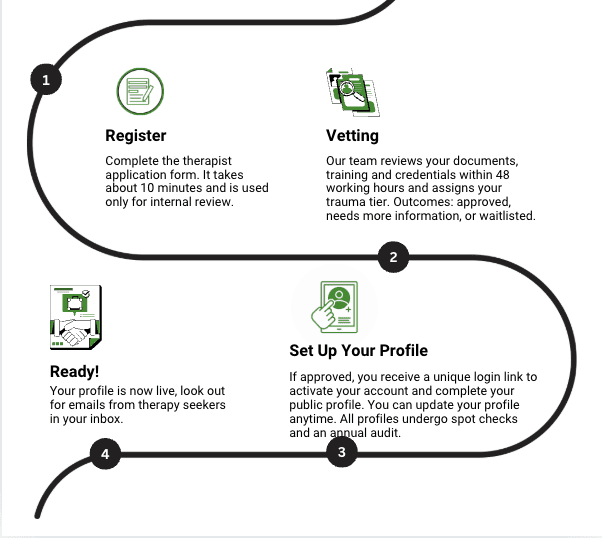
The Vetting Process
Professional Licence
Therapists must provide a current registry link, a good-standing letter (≤12 months) or a valid licence, confirming active status with no suspensions or restrictions.
Professional Membership
Active membership with a recognised professional body is required for all. Advanced/Specialist tiers may need extra trauma-related credentials.
Trauma-Specific Training
Certificates must include the training provider, modality, dates and hours. Requirements vary depending on the therapist’s tier placement.
Clinical Experience
Therapists self-attest to caseload, supervision, and clinical experience, which we review against our tier structure. Supervisor confirmation may be requested for clarification.
Additional Checks
When further verification is required:
Two professional references
A proficiency evaluation interview
Upcoming Planned Checks:
Professional indemnity insurance verification
Criminal background check
The Tier Structure
What do the Tier badges mean?
1) Trauma-specific training
A. 12–24+ hours of trauma-related education (can include modality-specific or broader trauma education on neurobiology, nervous system regulation).
B. 50+ hours of trauma-specific education, including formal certification in one evidence-based modality (EMDR, IFS, SE, Somatic Experiencing, Sensorimotor Psychotherapy) OR 5+ years of depth training across multiple modalities with 50+ documented hours.
C. 100+ hours of advanced training across multiple modalities with demonstrated competence and depth.
2) Experience & Caseload
A. 1–4 years of clinical practice with trauma clients; actively building depth and confidence across presentations.
B. 5+ years of clinical work with a significant trauma-focused caseload (trauma forms a regular, meaningful part of your practice) or accreditation in one modality.
C. 10+ years of clinical work with a predominantly trauma-focused caseload, including complex trauma presentations (PTSD, dissociative, attachment, and developmental trauma) or accreditation in two modalities.
3) Working with complexity/dissociation
A. Recognises red flags and prioritises safety; paces work appropriately for trauma clients
B. Works confidently with complex trauma, attachment disruptions, and somatic presentations under trauma-focused supervision
C. Routinely treats high-complexity and dissociative clients; demonstrates expert management of safety, pacing, and relational ruptures
4) Supervision & professional role
A. Engages in clinical supervision or consultation on trauma cases.
B. Receives ongoing trauma-specific supervision (typically monthly) and peer consultation.
C. Engages in or provides advanced trauma-specialist supervision, consultation, or teaching; actively contributes to the trauma community.
A: Trauma-Informed
Strong foundations and safety-led work; ideal for stabilisation and practical tools.
Recognised for providing safe, trauma-aware support.
B: Trauma Advanced
Deeper training and at least one depth modality; suited for CPTSD-type work.
Recognised for focused trauma therapy and depth-modality practice.
C: Trauma Specialist
Primary focus on complex trauma/dissociation with multi-modal depth practice.
Recognised for advanced trauma-specialist competence in complex presentations.
Not sure which trauma-care level fits?
Every professional in the Directory is reviewed against our standards. Each therapist is vetted and placed as Trauma-Informed, Trauma-Advanced, or Trauma-Specialist to help match your needs to their scope of practice.
Quality and Control Measurements
If you have a question that’s not covered in the FAQ, please email us at info@traumadirectory.org
How are clinicians vetted and placed into tiers?
We verify each therapist’s training, supervision, trauma-specific experience and, where applicable, legal licensure. Because global regulation varies, we assess competence holistically. Tier placement (Trauma-Informed, Trauma-Advanced, Trauma-Specialist) reflects a therapist’s verified scope of trauma practice so clients can make safe, informed choices.
What ongoing standards must therapists meet?
All therapists must maintain ethical accountability, comply with local legal and professional requirements, and engage in regular supervision. Re-verification occurs every 24 months and appears on each profile as “Verified as of [year].” We also recommend that therapists complete at least 12 hours of trauma-specific CPD within each 24-month cycle. Any change in status or emerging concern may trigger earlier re-verification.
Do you conduct audits or checks?
Yes. We run random spot-audits and may verify information directly with supervisors, professional associations or providers. Misrepresentation can result in badge removal and suspension.
How does the complaints and safety process work?
We offer a complaints pathway for concerns regarding practice or accuracy of information. When appropriate, we liaise with regulators or professional bodies.
How is my information handled during vetting?
All documents are reviewed only by the vetting team and processed in line with data protection standards.
What is the Directory’s overall commitment to safety?
We align with local laws and ethical codes, emphasise verified trauma competence, and work to make trauma care safer, clearer and easier to navigate worldwide. Our mission includes raising global standards, collaborating with governing bodies, and building a dedicated vetting and quality board of trauma professionals.